

Most e-commerce teams know that testing is important. Nevertheless, much optimization still happens too late.
A new landing page goes live. A new theme is published. Navigation changes. Product cards are redesigned. Only afterward does the team start looking for signals in analytics, heatmaps, conversion rates, and add-to-cart metrics.
The problem is that real testing requires real traffic. It takes time, it demands attention, and in the worst case, you expose customers to a poorer experience while waiting for data.
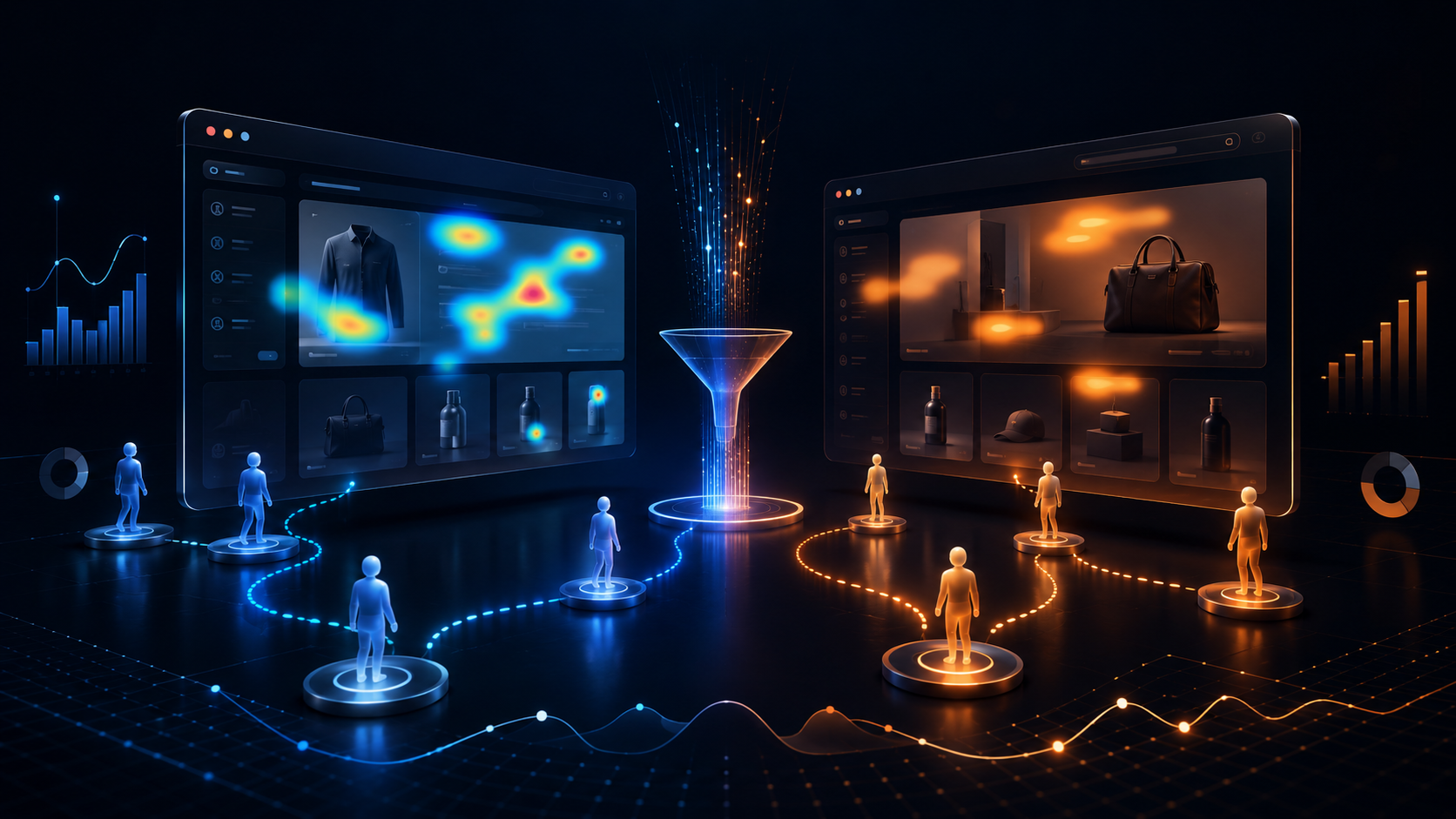
SimGym points to a different workflow: pre-launch CRO.
Instead of waiting for real customers to reveal friction, AI-simulated customers can test the store experience before the change is published. This doesn't replace real user data, but it provides a new checkpoint between design decisions and production.
From gut feeling to simulated purchase behavior
Traditional CRO often starts after something is live. The team launches, measures, analyzes, and adjusts. This works well for high-traffic stores with clear test hypotheses.
However, many Shopify stores don't have enough traffic to properly test every change. And even larger stores don't always want to risk conversion during critical periods.
SimGym uses AI-simulated shoppers to navigate a store experience. They can test different themes, product discovery, navigation, add-to-cart flows, and friction points before a change goes live.
For e-commerce teams, this means that CRO is moved earlier in the process.
It's no longer just about optimizing after launch. It's about reducing risk before launch.
Why this matters for enterprise commerce
For enterprise stores, storefront changes are rarely minor.
A seemingly simple change to a menu, product card, or campaign page can affect:
-
product discovery
-
internal search
-
add-to-cart rate
-
mobile navigation
-
campaign flow
-
B2B purchase journeys
-
checkout initiation
-
performance
-
content operations
When multiple markets, customer types, and product categories are involved, the risk increases. What works for one segment might create friction for another.
Pre-launch testing adds an extra layer of quality assurance. Not as a definitive answer, but as an early warning.
If simulated customers can't find products, get stuck in navigation, or opt out of a variant, the team should investigate why before the change is released to real traffic.
SimGym does not replace A/B testing
The most important thing is not to overestimate the technology.
AI-simulated customers are not real customers. They don't have full human context, brand sentiment, price sensitivity, or emotional decision-making logic. Real user data, A/B testing, customer service insights, and qualitative research are still necessary.
But SimGym can fill a gap that many stores have had for a long time: rapid pre-launch testing.
It's especially relevant when the team needs to:
-
compare new and old themes
-
test navigation changes
-
evaluate new product cards
-
quality assure campaign pages before peak seasons
-
assess mobile-first purchase flows
-
detect obvious UX friction early
-
add a data layer to design decisions before development is finalized
This is not a replacement for CRO. It is an earlier phase in the CRO effort.
What should the team test?
For Appsalon customers, there are three areas in particular where pre-launch CRO provides value.
1. Product Discovery
Do customers find the right product quickly enough? Do they understand category, filters, search, and product cards? This is often where new design either boosts or lowers conversion.
2. Purchase Intent
Does the customer move from interest to action? Add-to-cart, variant selection, size selection, bundle logic, and price display should be tested before the change goes live.
3. Operational Risk
Does the experience work across markets, devices, and customer types? Enterprise stores often need to balance D2C, B2B, campaigns, local payments, pickup, returns, and inventory logic within the same storefront.
What does this mean for Appsalon customers?
SimGym is interesting because it shows how Shopify is integrating AI into the build process itself.
AI isn't just about how customers find products. It's also about how teams build, test, and improve their store.
For brands with high traffic, multiple markets, or complex storefronts, pre-launch CRO should become a regular part of the workflow. Not because AI simulation provides perfect answers, but because it can uncover problems earlier.
Used correctly, SimGym becomes an additional checkpoint in the launch process:
design → development → simulated testing → adjustment → publication → real measurement
This leads to better decisions, lower risk, and faster learning.
In modern Shopify architecture, testing isn't just something that happens after launch. It should be built in before the change reaches the customer.
Share:
B2B on Shopify Plus – professional commerce solution for businesses
Shopify AI Toolkit: What it Means for Development Teams